
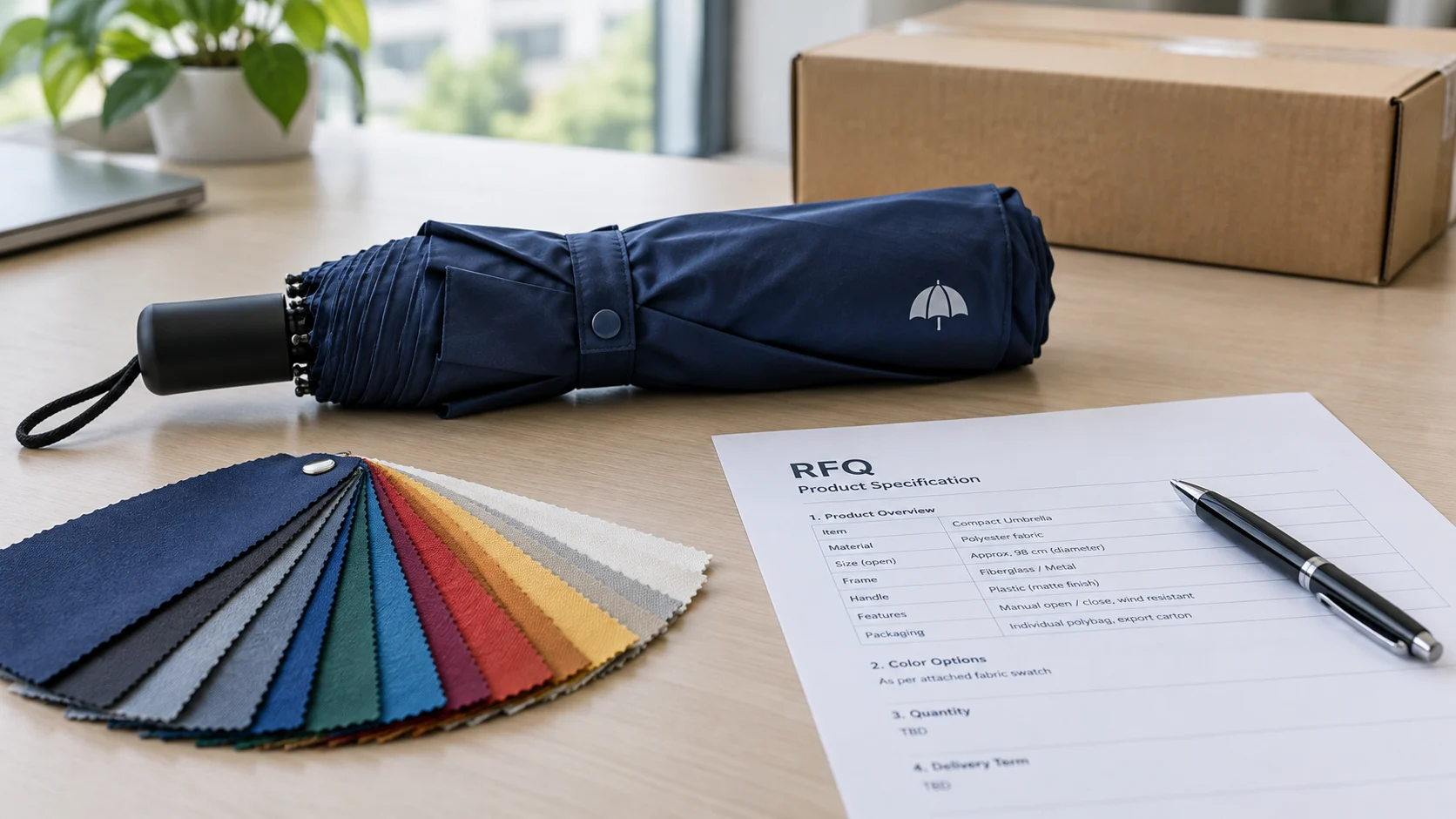
There is no single figure for custom umbrella minimum order quantity. The MOQ on a quote is usually set by the hardest part of your specification to produce in small volumes: a canopy fabric dyed to your brand color, a printing setup, a new frame part or a printed retail box. That is why two quotes for “an umbrella with our logo” can show very different minimums. This guide explains how umbrella MOQs are built up, how they affect unit cost, and how to plan a first order that fits your budget and timeline.
Key points for buyers
- An MOQ usually applies to one defined specification: model, size, canopy color, artwork and packaging.
- The most customized component tends to set the minimum for the whole umbrella.
- Stock fabric colors, simpler printing and standard packaging are the usual routes to a smaller first order, at the cost of less brand control.
- Before comparing suppliers, ask whether each MOQ is per model, per color, per artwork or per packaging item.
What minimum order quantity means for a custom umbrella order
MOQ is the smallest quantity a supplier will produce for one defined item. In umbrella projects, “one item” normally means one combination of model, open size, canopy color, frame, handle, logo artwork and packaging. Change any of these and you may have created a second item with its own minimum.
A single quote can also hide several minimums. The umbrella itself, the canopy fabric, a printed sleeve and a gift box may each come from different upstream sources, and each source can have its own minimum run. When a quote shows one MOQ, it is reasonable to ask which component that figure is based on.
Per order, per design or per color
Some suppliers set a minimum per order or per order value; others set it per design or per colorway. If you plan three logos or three canopy colors, this changes the arithmetic. Each version may need to reach the minimum on its own, or the supplier may let versions share a production run when the umbrella model and fabric stay the same. Confirm which rule applies before you split quantities.
Why umbrella suppliers set an MOQ at all
An MOQ is mostly a way of covering fixed work that happens once per run, whatever the quantity. The main sources are:
- Canopy fabric. Polyester and pongee in common colors may be available from fabric stock. A Pantone-matched color usually needs its own dye lot, and fabric is dyed in lengths that can exceed what a small order uses.
- Printing setup. Screen printing needs a screen for each color plus setup and test prints. Other methods have different setup costs, but almost every method has some fixed preparation.
- Frames and components. Standard ribs, shafts and handles are bought in volume. A custom handle shape, colored shaft or branded runner may require a mold or a minimum purchase from the component maker.
- Packaging. Printed sleeves, hang tags, labels and color boxes are separate print jobs with their own minimums.
- Production changeover. Cutting, sewing, assembly and inspection lines need to be set up for each specification.
A lower MOQ is therefore not free. When a supplier accepts fewer pieces, the same fixed work is spread across fewer umbrellas, so the unit price usually rises. Whether that is acceptable depends on whether you are testing a market or running a full program.
What drives custom umbrella minimum order quantity
The table below shows how common specification choices tend to push the minimum up or down. Actual thresholds vary by supplier and model, so treat it as a planning tool rather than a price list.
| Specification choice | Usually more MOQ-flexible | Usually raises the MOQ | Trade-off to weigh |
|---|---|---|---|
| Base model | Existing model and open size | New frame, new size or modified opening mechanism | Existing models limit differentiation; new structures add sampling time and possible tooling |
| Canopy color | Color available from fabric stock | Pantone-matched color or special fabric (coated, UV, special weave) | Stock colors may sit close to, but not exactly on, your brand color |
| Logo artwork | One- or two-color logo on one or a few panels | Multi-color logos on every panel, or full-canopy designs | Simpler artwork costs less to set up but gives less brand coverage |
| Printing method | A method whose setup suits your quantity and artwork | A setup-heavy method chosen for a small run | Ask which method the supplier recommends at your quantity; some methods favor large runs, others suit complex art at modest volumes but cost more per piece |
| Handle and parts | Standard handle and runner in standard colors | Custom-molded handle, branded tips or colored components | Branded parts add perceived value but often carry their own minimums |
| Packaging | Standard sleeve, polybag and export carton | Printed sleeve, hang tag, color box, retail barcode labels | Retail packaging can have a print minimum that is independent of the umbrella |
In practice, the effective minimum for the finished umbrella is often the highest of these. If one component drives the number, simplifying that component alone can change the whole quote.
Logo on an existing model vs fully custom production
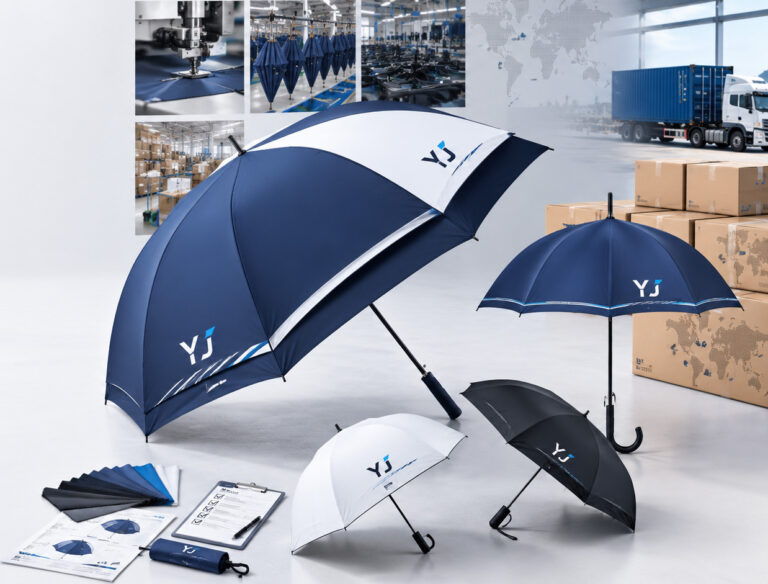
Most umbrella orders fall into one of two routes, and their minimums are not comparable. Mixing them up is one of the most common reasons buyers think one supplier is “much cheaper” than another.
Logo on an existing model
The umbrella structure and fabric colors already exist; customization is mainly the logo print and, sometimes, packaging.
Suits: event giveaways, trade shows, first orders and market tests.
Trade-off: limited color and structure choice, and other buyers can order the same base model.
Fully custom umbrella
Fabric color, frame, handle, print layout and packaging are specified for your program, often with a pre-production sample.
Suits: private label lines, retail programs and distributor ranges.
Trade-off: higher minimums, more approval steps and a longer sampling stage.
If you are developing your own range, the scope of OEM and ODM umbrella projects explains what is typically defined at each stage.
How MOQ varies by umbrella type
Umbrella type changes where the minimum comes from, even when the logo is the same.
- Golf umbrellas use more fabric per piece and are often specified with double canopies, custom colors or large prints. A brand-color canopy or full-canopy artwork is the usual MOQ driver. See the golf umbrella options for typical structures.
- Folding umbrellas have more parts (multi-section shafts, automatic mechanisms) and are often sold with a printed sleeve. The frame is usually standard; the sleeve and retail packaging are common sources of extra minimums. Compare the folding umbrella structures before fixing your spec.
- Straight umbrellas are simple structurally, but handle choices such as wood or custom shapes can depend on component availability.
- Promotional umbrellas are usually built on standard models, which is why they tend to offer the most flexibility on quantity.
How MOQ, unit price and total cost interact
A simple way to read a quote: unit cost is roughly the variable cost of one umbrella plus the fixed setup cost divided by quantity. As quantity rises, the setup share per piece shrinks, which is why suppliers often quote price tiers. The reduction usually flattens out at higher volumes, so ordering far beyond your need to chase a lower unit price can cost more overall once storage and unsold stock are counted.
When comparing offers, look past the unit price:
- Sample and setup charges. Ask whether they are billed separately or credited against the bulk order.
- Freight per unit. Small shipments often cost more per umbrella to ship, and the shipping method may differ. Review packaging and shipping arrangements early, because carton size and packing method affect this.
- Quantity tolerance. Printed and custom goods may ship slightly over or under the ordered quantity. Agree the tolerance in writing.
- Destination charges. Duties, taxes and clearance fees apply per shipment regardless of order size.
Practical ways to start with a smaller custom order
If your quantity is below a supplier’s stated minimum, these options are worth discussing. Each one gives something up, so pick the ones that matter least to your project.
- Choose a stock canopy color. This avoids a dye lot. The trade-off is that the color may not match brand guidelines exactly.
- Simplify the print. Fewer colors and fewer printed panels reduce setup. You lose some visibility, so check the umbrella logo printing options to see what still works at your quantity.
- Keep one base umbrella across versions. If different logos or departments use the same model and fabric, they may share a run. The trade-off is less product variety.
- Use standard packaging first. Move to printed boxes or hang tags on a repeat order once demand is proven. Retail presentation is weaker on the first run.
- Ask about a below-MOQ arrangement. Some suppliers accept smaller runs with a surcharge or with simplified specs. Useful for tests, but the unit price is higher.
- Approve a sample before committing. A sample confirms structure, color and print before you decide on volume. It adds time and a sample fee; the sample policy outlines the sample types usually involved.
- Combine needs into one production. Planning several events or seasons together can bring you above the minimum. The trade-off is cash tied up in stock and the need for storage; ask whether split shipments are possible rather than assuming they are.
Common buyer mistakes with umbrella MOQs
- Asking for “your MOQ” without a specification. The answer depends on the spec, so a vague question gets a vague or misleading number.
- Assuming one MOQ covers a color mix. A minimum quoted for one canopy color may apply to each color separately.
- Comparing different routes. A minimum for a logo on a stock model is not comparable with one for a fully custom umbrella.
- Forgetting packaging minimums. A printed box can carry a higher minimum than the umbrella itself.
- Changing details after sample approval. A new color or print change can reset material or setup requirements and affect cost and schedule.
- Choosing on the lowest MOQ alone. Check how a low minimum is achieved: which parts are stock, which are custom, and whether that matches what you need to sell.
MOQ checklist for your umbrella RFQ
Sending the right details up front lets a supplier tell you which choices drive the minimum, instead of quoting a generic figure.
Include in your request
- Umbrella type, open size and intended use
- Quantity, ideally as a range (minimum you need and maximum you would consider)
- Canopy color(s), with Pantone references if brand matching matters
- Logo artwork, number of print colors and print positions or panels
- Frame, handle and opening preferences, if any
- Packaging: sleeve, labels, hang tags, boxes, carton marks
- Destination country and target delivery date
- Whether repeat orders are likely
Ask the supplier
- Is the MOQ per model, per canopy color, per artwork or per packaging item?
- Which component sets the minimum on this quote?
- What would change if we used a stock color or a simpler print?
- Is a smaller run possible, and how would price or specification change?
- Can you quote two or three quantity tiers?
- What sample type do you recommend, what does it cost, and is the fee credited?
- What over- or under-shipment tolerance applies?
How YJ Umbrella approaches MOQ questions
YJ Umbrella does not publish one universal minimum. Its published FAQ states that MOQ depends on the umbrella type, materials, printing method, customization level and packaging, so minimums are reviewed project by project. In practice, the more complete your specification, the more precisely the team can say which element sets the minimum and whether a simpler alternative would lower it.
That review is also useful if you are still comparing suppliers: knowing which component drives the number lets you compare quotes on a like-for-like basis.
Custom umbrella MOQ: frequently asked questions
Is there a standard MOQ for custom umbrellas?
No. Minimums depend on the supplier, the umbrella model and how much of it is customized. A logo printed on an existing model usually allows smaller quantities than a fully custom umbrella with brand-matched fabric and printed packaging.
Can I mix colors or logos to reach the minimum?
Sometimes. If the versions share the same model and fabric, a supplier may allow them to run together. If each version needs a different canopy color or setup, each one may need to meet its own minimum. Ask before you split quantities.
Does a sample order count toward the MOQ?
Usually not. Samples are a separate step to confirm the product before bulk production. Some suppliers credit part or all of the sample fee against a confirmed order, but this varies and should be agreed in writing.
Why did two suppliers quote very different MOQs for the same umbrella?
They may be quoting different things: one may assume a stock color and standard packaging, the other a matched color and printed box. They may also have different fabric sources or printing equipment. Ask each which component sets the figure.
Will ordering above the MOQ always lower the unit price?
Not in a straight line. Setup costs are spread more thinly as quantity grows, so prices often fall in tiers, but the reduction usually slows at higher volumes. Compare total landed cost, including freight and storage, not just the unit price.
Check the minimum for your exact specification
The quickest way to get a meaningful custom umbrella minimum order quantity is to share the details that drive it. Send your umbrella type, quantity range, canopy color, artwork and packaging needs, and YJ Umbrella will review which options fit your volume.
